US Naval Academy Commencement Week

Commencement Week for the US Naval Academy in Annapolis Maryland is a major event for both the Graduates and Midshipman at the Academy, and also for the city of Annapolis. Besides the influx of families and friends of the staff, instructors and the Midshipman, it attracts tourists from all over the United States and the rest of the world. Probably the biggest draw and most anticipated event is the flight demonstration performed by the Navy's Blue Angels precision flying squadron.

Some History
At the end of World War II, the Chief of Naval Operations, Chester W. Nimitz, ordered the formation of a flight demonstration team to keep the public interested in Naval Aviation. The Blue Angels performed their first flight demonstration less than a year later in June 1946 at their home base, Naval Air Station (NAS) Jacksonville, Florida. LCDR Roy "Butch" Voris led the team, flying the Grumman F6F Hellcat.

Adding Some Ventilation Inside The Boat

If there is any one thing that people object to on a boat the most, it is unwanted smells. And as a boat gets older, it develops smells from all kinds of sources. There are volumes of information out there on holding tank and head odors so we did not plan to address them with this minor modification. After almost 20 years of living aboard, we have found that certain areas of the boat can develop odors from trapped moisture and condensation in any climate and any season. A bigger problem that can surface is mold and mildew, which can generate odors and also cause health problems in some individuals. We learned all of these lessons the hard way, and the solutions were actually quite simple.

The secret to keeping a boat odor and mold and mildew free is ventilation, ventilation and, of course, ventilation. Fans, air-conditioning and heating systems all help in the ventilation department. Other things like leaving hatches or ports open, even a crack, make a big difference, and fans and solar vents make huge improvements. But none of this will help much if there are compartments all over the boat that have no way to exchange air, and allow air to flow in and out. These enclosed compartments are further insulated by cushions and mattresses, not to mention latches that keep the access closed tight. Almost all boat builders want the interior surfaces to look as smooth and unbroken as possible, but once again, this contributes to the problem.

In our current boat, and the previous one that we cruised and lived aboard for 17 years, we took some time to open up all of the interior space to air circulation. Using a hole saw, we drilled ventilation holes inside the cabinets and lockers so the air can flow from one end of the boat to another. We use 12 volt computer fans strategically placed to assist the circulation process, since they are extremely quiet, use very little power and will run continuously for long periods of time. We also use a dehumidifier that runs all year long when we are plugged into the dockside power. It is incredible how much moisture it pulls out of the air, no matter what season and no matter whether we are running the air-conditioner or the heater.

The weekend was set aside to work on the circulation issues and make some improvements. The forward v-berth was a particularly problematic area. It seemed to always be damp, and since the anchor locker was forward of it and the shower just aft of it, this was a moist environment. The dehumidifier sits in this cabin and blows the treated, dry air up into the main salon from where it sits. But we knew we needed to get the area under the v-berth circulating air and with 5 inch cushions on top, this was only going to be accomplished by cutting vents in the side. The two berths in the aft cabin are the same with the added problem of water tanks under each berth. We store lots of items, including clothing, under these berths so it needs to be dry and odor free.


In the past, we have used a variety of vent grills. Our previous boat had an all teak interior just as this one does. So naturally we use teak grills for that finished look. But aside from the fact that these teak grills are way too expensive, in my opinion, need to be varnished and the slats are easily broken if something heavy inside the locker falls against them. We have had this happen on more than one occasion.We have used stainless steel grills and they work fine, but just don't look right to us. With the areas we wanted to cover done in a dark teak, we were concerned that anything white would stand out too much. So our options were black or brown, and square or round. The brown grills we could find were either too flimsy or designed to have an air-conditioning duct attached, and stuck out too far in the back. We found a nice, sturdy, black, round grill and ordered 6 of them to do the surfaces we wanted to vent.

The installation part was very simple. We used the appropriate size hole saw to drill through in the location we wanted the vent. We measured carefully to be sure it was centered where we wanted it, and took care that there was nothing behind the spot that could be damaged by the hole saw. When a hole saw is used on teak plywood, it is best to start the hole on one side and before it goes all the way through, finish drilling from the other side. This keeps the wood from splintering as the saw passes through the opposite side. Before we attached the grills, we took the time to sand the teak around the area the vent would be placed and put a coat of varnish on the wood. This way, once we start re-varnishing the interior, these areas will be done and we won't have to remove the grills again for a long time.


Storage And Stowage On A Liveaboard Boat

Anyone that has lived aboard or considered living aboard a boat understands the issues with finding enough space to stow all of your life's possessions. The builders and designers of boats are more interested in bragging that their 35 foot boat will sleep 10 and seat 15 for dinner. What they don't provide is space on the boat to store the bedding for 10, nor the dishes and provisions to feed 15 people. In almost every boat there is a great deal of wasted space along side the hull, behind steps and cabinets and many other areas. So we boat owners need to get very creative if we don't want to spend the dollars for a very large boat just to haul all of our stuff. With every boat we have purchased, we spend the first hour sitting in the main salon asking one question. Where will we put everything we need to be comfortable and enjoy cruising. If we can not quickly answer that question, we move on to the next boat.

Beach House presented that problem since she is 34 feet long and we were transitioning from a 40-foot sailboat with more storage than most sailboats in the 50 foot range. As we sat and pondered the question, we realized the fit would indeed be tight. We had looked at several boats after we sold our Mariner 40 Sea Trek and found quickly that the storage on many of these boats hardly covered weekend cruises, let alone full-time cruising, and these were some very well-known popular boats. With Beach House, we had to do some serious research to figure out if we could indeed find the additional space. After several more weeks of looking and reconsidering our options, we finally came to the conclusion that we could make it work. The deal was done and we began the process of moving aboard.


The galley area holds 4 large drawers, 2 cabinets and a large open area under the windshield. The drawers were optimized using plastic dividers and small plastic baskets wherever they would fit. The area under the windshield would hold additional galley implements stored in wicker baskets, and glass and plastic containers that could have their lids secured. We also have large open shelves at the aft end of the main salon that would be utilized as storage for most of our snacks, chips, cereal, etc. again using wicker baskets, large zipper-type plastic bags and air-tight plastic containers. We used a non-skid drawer liner found in rolls at most hardware stores to keep everything from sliding around. Hanging fishnet bags are great for fruits and baked goods, and lots of other things. Hanging cup holders are used to slide wine glasses and stemmed tumblers into, allowing them to hang upside over the shelf in the main salon, freeing up the available cabinet space for vertically stacked plates and stacking cups.

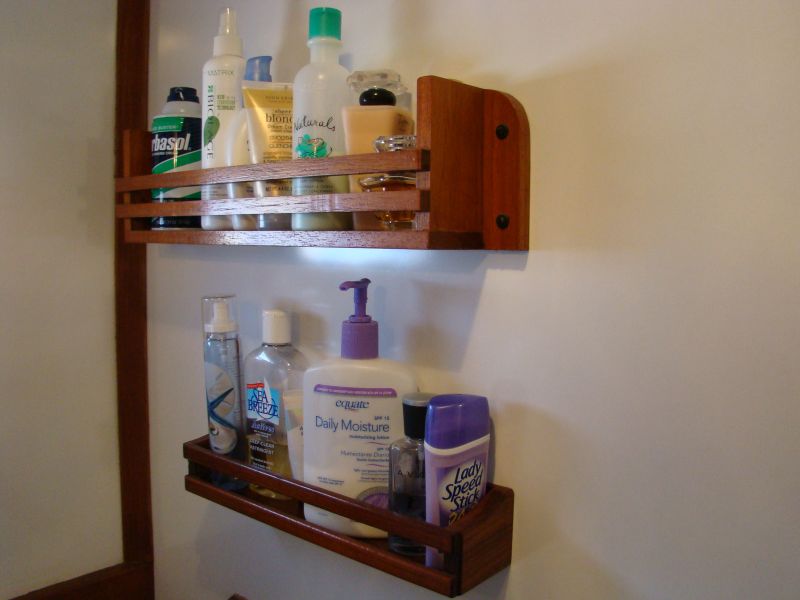
In the heads, we used plastic baskets inside the cabinets to divide items and organize things to get more in the cabinets than if we just piled it in and had to sort through things every time we needed something. Here again, we used hanging net bags for paper items, and they stayed much dryer than being stuffed inside lockers. We used several off-the-shelf items found in both regular hardware stores and marine chandleries. Small teak racks strategically placed will hold all of those shampoos and sundry items we all need. We also found small stainless steel and textaline hanging storage containers at local hardware stores that attached to the bulkheads with large suction cups. Small hammocks strung up along the inside of the hull will store a great deal of all kinds of items. Towel bars and towel racks can be used to store several towels and wash cloths that might normally be stored in a drawer or locker. Cleaning supplies could be stored on the shelf that the head is mounted on, in plastic containers to keep things organized.


And those are the easy things to do. Now it is time to get creative. Our water tanks are under our bunks in the aft cabin and take up most of the area under the bunk. The area not filled by the tank is used to store several power tools that are not used that often because getting in and out from under the bunk is not always that easy. There is almost always space behind most drawers that is not used perhaps because of hull shape. This room to can be used for storage, keeping in mind that the drawer will need to be removed to get to it. Large areas under seats and settees are usually available to store larger items and bins with lids for cloths, linens, paper goods, tool boxes and pretty much whatever will fit. Items such as chartbooks and placemats can be stored under seat cushions and mattresses. It keeps them flat and readily available.

The next step is to look for small modifications that can pay off in a big way. We found that there was space under the bottom step that actually would accept large flat plastic containers like those used to store items under a bed. By removing the step tread and the front of the bottom step, we found the plastic containers could be slid inside the steps and with very little carpentry work. The front and tread could be easily removed and replaced to gain access to this otherwise unusable space. Also, the space between the first and second step was deep and open. We enclosed the area just under the first step with a nice piece of teak with an opening cut in it to allow shoes and other items to be stored where normally there would be nothing. Because we cut this in an oval shape, we used split electrical wire loom that fit over the cut edges to finish it off. Large open areas such as under the forward v-berth can be sectioned off and allow much more to be stored than if it were a big open area.


There a few other tricks we can use to keep the need for storage down to a minimum. Almost every live-aboard we know has a large portable dock box. These can be anywhere from a small second car to an older-model station wagon to a full-size utility van. For years, we used a Chevy Astro van until it just got too tired and was recently replaced. We used our "dock box" to store items we might not need on the boat, but wanted access to on a regular basis. With the sailboat, this meant, among other things, our extra sails, things we might need and use for repairs and projects and some larger tools and tool boxes, are also stored here. We also used the vehicle to store clothes when we didn't need them. Being in a northern climate, we store winter clothes in the summer and summer clothes in the winter. We have found this to be much simpler and the clothes more protected by using "Space Bags" that can be compressed by using the suction end of a vacuum cleaner. Since the vehicle is just at the end of the dock, it comes in handy and also provides a second vehicle when we need it. If you look around your boat, and use your imagination, we bet you too, can come up with some pretty creative ideas to get that extra storage space you never thought you had. If all else fails, local storage facilities will rent you a small room for a reasonable rate to get clutter out of your way while you are dockside.

Remaking The Boat Shower Take 2

DSC04034a

Unfortunately, work has seriously interfered with the boat projects and this winter saw very few of the items on my to-do list get done. One project that we did start before the blizzards set in was to redo the shower in the forward head. We had converted the head into a shower when we first moved on the boat, but it was a temporary fix and we planned on a more permanent finish later. Later began in December after the boat was hauled and we moved ashore. I began taking the old Formica like material off of the walls and planned to replace it with FRP panels that would look better, be completely waterproof and easy to clean. These are the typical panels found inside many shower enclosures.

DSC04235aFirst we had to remove the mirror, towel bars, soap dishes, teak racks, and whatever items were attached to the walls, and remove the sink, which slides out from behind the head and has a diverter in the faucet for the shower hose. The plumbing lines to the sink had to be capped off so we could use the fresh water system until the project was completed. Then the original wall covering could be removed. The old material was actually quite easy to remove with a heat gun and a wide scraper. With a few passes of the heat gun and the scraper behind the panel, as soon as the old adhesive warmed up a bit, the panel pulled loose. It was a bit tedious but the panels came off in large pieces with minimum effort and since the old adhesive that held them up was pretty thin, there was only a little sanding DSC04035aneeded to get the plywood behind it ready for the new panels. Once the old panels were off and the plywood sanded, we used a two part penetrating epoxy to further seal the walls against water intrusion. The under-layer of plywood was in excellent condition and there were no signs of water leaking into it at any point. This was probably because none of the past owners had ever installed a shower on the boat in either head. With the walls now sealed, it was time for the next step.

DSC04245aSince there are no square corners on a boat, simply measuring an area and cutting the panels to fit would not quite work for us. So it was necessary to make templates for the three areas we would be covering with the panels. We needed something that would allow us to work in the small space and still be rigid enough to maintain its shape and size when we transferred the shape to the FRP panels. After a little thought and a walk through the local hardware store, we settled on using underlayment for Laminate Flooring. It is very inexpensive, comes in 48-inch rolls and has just the rigidity needed. By cutting sections just slightly larger than the area for which we needed to make the template, the material was taped to the longest straight run on the wall. Then, the material was marked off with a felt pen and cut to size with a pair of scissors. Once cut to size, the templates were placed back on the walls to be sure the fit was right.
 
DSC04340aNext the templates were transferred over to the panels, placing them in reverse on the back of the panels and marking them with a felt marker. The panels were cut with our Ryobi battery operated circular saw and a saber saw, both with fine blades for cutting plastic. The circular saw made all of the straight cuts and the saber saw did all of the irregular cuts. Once the panel was cut it was held up on the wall and dry fitted. They usually needed a little adjustment depending on how complicated the pattern was. We had also purchased the inside and outside corner moldings for the panels so they were also cut to size. Placement of the moldings need to be considered, since they fit behind the panels, you have to determine when the molding needs to go on in relation to the panel already up and the next one to go up. Once all of the pieces of the puzzle were cut and their fit confirmed, it was time to attach them to the wall. There are a few options to glue the FRP panels to the walls, and we chose the Liquid Nails specifically for these panels.

DSC04304aThe Liquid Nails adhesive was removed from the can and smeared on the plywood with a putty knife and then spread out over the area with a notched trowel like those used to apply adhesive for ceramic wall tile. The notches apply just the right amount of adhesive as long as the entire surface is covered, being careful to not leave any bare spots. The adhesive requires that the material be set into it within 45 minutes or before the adhesive begins to skin over. With this in mind, we did each of the three sections, one at a time. In addition to the adhesive, all corners were thoroughly caulked with 3M 4200 to insure water would not leak into the corners. With good coverage with the adhesive and the panels in place, it DSC04305awas necessary to place braces made from 1”x 2” strips between the panels and the opposite wall, to hold the panels tight into the adhesive until it had time to dry. This was due to the rigidity of the panels and the tendency to pull away where the walls or panels were bowed.

DSC04338a
With all of the panels in place, the shower was beginning to take shape. The bottom edges where the panels meet the shower pan would need to be sealed completely. This is usually the area that will leak first if that were going to happen. For this, we used a vinyl strip that could be folded and would cover both the bottom of the panel and the lip around the pan. The corners have also been caulked thoroughly with 3M 4200 to seal everything and keep it that way. Next, the moldings where the panels meet the ceiling had to be installed. With the corner moldings in place and allowed to dry thoroughly for a day or two, we could begin the process of reinstalling everything back in place for the towels and various sundry items we use in the shower. Instead of just reinstalling everything back where it was, we planned where everything would go to keep the things that needed to stay dry in certain areas and also placing anything that would protrude from the walls in areas that would not cut down on space when we shower.
 
DSC04339aAll items attached to walls where sealed with caulking so that even the screw holes could not leak. We added a shower curtain slide system on the ceiling that would allow the shower curtain to slide easily but would keep it close to the walls. This gave us maximum space with the shower curtain in place and left a feeling of openness to the shower. Towel rings, teak racks, the mirror and a shower caddy for soap, shampoo, wash cloths, etc. all went in strategic locations. Everything worked out just as we planned and the shower turned out to be all we had hoped for. While we had the sink removed, we used to opportunity to paint areas that were hard to get to, like the inside of the hull behind the DSC04308asink. We also painted the area under the head where the new thru-hull had been installed before we launched. Once the project was completed and we had our first shower of the season on board, we were very pleased with our modifications. And the entire shower proved to be very water tight as we had hoped. Now for the next project.

DSC Radio Safety Alert


With the proliferation and popularity of DSC radios, we felt you needed to be advised of this important potential safety issue. The following is a Safety Alert issued by the U.S. Coast Guard:

Dangers Associated with Automatic Channel Switching on Digital Selective Calling (DSC) Equipped VHF Marine Radios

It has come to the Coast Guard's attention that an automatic channel switching feature found on certain models of Digital Selective Calling (DSC) equipped VHF marine radios may create an unintended hazard by automatically switching from a working channel that might be in use at the time to Channel 16 when the VHF marine radio receives a DSC distress alert, distress alert acknowledgment or other DSC call where a VHF channel number has been designated.

This could happen without a vessel/radio operator's immediate knowledge and could initiate an unsafe condition by which the vessel/radio operators would believe they were communicating on a working channel such as Channel 13 when, in fact, they were actually on Channel 16. Imagine a towboat operator on the lower Mississippi River making passing agreements on VHF channel 67 and then suddenly, without warning, not being able to quickly reestablish communications with those vessels because his/her radio automatically switched to Channel 16 instead. Since this unsafe condition can happen at any time, the Coast Guard strongly recommends disabling the automatic channel switching feature when maintaining a listening watch or communicating on the designated bridge-to-bridge radiotelephone, or while monitoring the vessel traffic services (VTS) channel. Radios that lack the disabling feature should not be used for bridge-to-bridge or VTS communications.

The International Telecommunications Union Sector for Radiocommunications, Recommendation M.493-11 published in 2004 and later versions require DSC-equipped radios to provide for disabling of this channel auto-switch feature. In the United States, the Federal Communications Commission (FCC) requires all DSC-equipped radios certified after March 25, 2009 to meet this requirement. Manufacturers that do not provide a disable function are encouraged to do so and to inform their customers if means for correction exist. Updated information including a listing of manufacturers of radios believed to be affected by this Safety Alert will be posted as available at http://www.navcen.uscg.gov/marcomms/gmdss/dsc.htm .

The Coast Guard strongly reminds radio operators and other users to always ensure they are on the proper operating channel when communicating or maintaining watch, particularly with DSC-equipped radios capable of channel auto-switching.
This safety alert is provided for informational purposes only and does not relieve any domestic or international safety, operational or material requirement.

Developed by the Spectrum Management and Telecommunications Policy Division (CG-652),
United States Coast Guard Headquarters, Washington, DC. Questions should be directed to Mr. Russell Levin at (202) 475 3555 or Russell.S.Levin@uscg.mil

Coast Guard Sets Weather Buoys In The Chesapeake

Coast Guard
 Modernization Banner
5th District Public Affairs
U.S. Coast Guard
Department of Homeland Security Coast Guard logo
Photo Release
Date: March 16, 2010
(410) 576-2541

NOAA your weather

Coast Guard, NOAA set seasonal buoys to gather weather data

BALTIMORE - Seaman Christopher Schwann, a 
crewmember aboard the 
Coast Guard Cutter James Rankin, washes a sinker as part of routine buoy
 maintenance in the Chesapeake Bay Monday, March 15, 2010. The Rankin 
replaces ice buoys in spring and sets them again in fall annually. U.S 
Coast Guard photo by Seaman Apprentice Grace Baldwin.
BALTIMORE - Crewmembers aboard the Coast Guard
 Cutter James 
Rankin, prepare to mount additional data gathering equipment to a 
weather buoy before setting it in the Chesapeake Bay Monday, March 15, 
2010. The weather buoy, developed by the National Oceanic and 
Atmospheric Administration gathers weather related data to include wind 
speed, temperature and wave height. U.S. Coast Guard photo by Seaman 
Apprentice Grace Baldwin.
BALTIMORE - Petty Officer 2nd Class Daniel 
Adams, a Boatswain's 
Mate aboard the Coast Guard Cutter James Rankin, maintains control of a 
weather buoy before lowering it into the Chesapeake Bay Monday, March 
15, 2010. Weather buoys contain data gathering equipment that enables 
researchers to monitor weather conditions such as wind speed, 
temperature and wave height. U.S. Coast Guard photo by Seaman Apprentice
 Grace Baldwin.
BALTIMORE - Petty Officer 2nd Class Tonya 
Mills, Boatswain's Mate 
aboard the Coast Guard Cutter James Rankin, measures the chain to ensure
 it is still in good condition Monday, Mar. 15, 2010. The Rankin 
annually inspects each aid to navigation to ensure that navigational aid
 is in good working order and marking safe water for mariners. U.S. 
Coast Guard photo by Seaman Apprentice Grace Baldwin.
BALTIMORE - Crewmembers from the Coast Guard 
Cutter James Rankin, a
 175-foot coastal buoy tender homeported in Baltimore, prepare to 
release a weather buoy in the Chesapeake Bay Monday, March 15, 2010. The
 Coast Guard works with the National Oceanic and Atmospheric 
Administration to place weather buoys that enable researchers to gather 
real-time weather data. U.S. Coast Guard photo by Seaman Apprentice 
Grace Baldwin.
BALTIMORE - Seaman Danielle Phelps, a 
crewmember aboard the Coast 
Guard Cutter James Rankin, mans a tagline in order to maintain positive 
contraol of a buoy moving across the deck before being placed into the 
Chesapeake Bay Monday, March 15, 2010. Safety is paramount throughout 
the Coast Guard and is especially important during dangerous buoy deck 
evolutions. U.S. Coast Guard photo by Seaman Apprentice Grace Baldwin.
BALTIMORE - Crewmembers aboard the Coast Guard
 Cutter James Rankin
 repair a damaged buoy in the Chesapeake Bay Monday, March 15, 2010. The
 Rankin is responsible for more than 375 aids to navigation that mark 
safe water for mariners in the Chesapeake Bay. U.S. Coast Guard photo by
 Seaman Apprentice Grace Baldwin.

BALTIMORE - The Coast Guard along with the National Oceanic and Atmospheric Administration conducted seasonal buoy replacements Monday in the Chesapeake Bay.
The Coast Guard Cutter James Rankin, a 175-foot coastal buoy tender homeported in Baltimore, maintains approximately 375 aids to navigation and conducts fall and spring buoy replacements annually.
Weather buoys collect data and report real-time environmental information including wind speed, temperature and wave height. The buoys also serve as interpretive buoys that mark the Captain John Smith Chesapeake National Historical Trail that runs throughout the Chesapeake Bay.
"The weather buoys provide valuable weather information during peak recreational boating seasons," said Lt. Dave Lewald, the commanding officer of the Rankin. "The buoys also provide historical data which can benefit researchers collecting information on how to clean up the bay."
Click on the photos above to view a higher resolution version and more specific caption information on the Coast Guard Visual Imagery site.
For more information visit www.ndbc.noaa.gov or visit http://www.ndbc.noaa.gov/station_page.php?station=44043 to view data from the weather buoy pictured above.

Installing a Power Inverter

There may still be cruisers out there that light their way with oil lamps, use a bucket instead of a head and sail without a motor, but in 18 years of cruising we have not met them. Today, most cruisers are like us, preferring to take the comforts and conveniences of life ashore with them when they cast off the dock lines to sail off into the sunset. Long ago we made the decision to cruise in comfort and not turn our sailing trips into a camp out on the water. This meant we would need a means to power our small appliances, power tools and entertainment devices. There is more than one way to accomplish the same end depending on the level of your power consumption and what your budget might be. For us the requirements were simple. The cost needed to be kept down, the system needed to be as simple as possible, and we needed to be able to install and maintain it ourselves. Additionally, it should not interfere with our piece and quiet, or that of our neighbors. OK, maybe not so simple after all.

Dehumidifier Recall


We try and post any safety issues we find that would have a affect a broad number of boaters and we feel this is an important one since many of us in all climates along the eastern seaboard especially, could be affected. We use a dehumidifier all of the time on board Beach House but not any of the ones affected by the recall. Nothing is more frightening and devastating for boat owner like a fire so we considered this one important. This humidifiers can be purchased on line or at many home improvement stores. Check the link and be sure yours is not included

The U.S. Consumer Product Safety Commission has issued a recall of 98,000 dehumidifiers sold under the Goldstar and Comfort-Aire brands between January 2007 and June 2008. The model in question, manufactured by China's LG Electronics Tianjin Appliance Co., has a 30-pint resevoir with a front-loading bucket, and a red shut-off button. This unit has been determined to be the cause of a number of fires — and we all know how boat fires usually turn out. To see if your dehumidifier is on the recall list, check this site.

Coast Guard Rescue Off NC Coast


News Release

Date: January 03, 2010

Contact: 5th District Public Affairs
(757) 398-6272

Coast Guard, Navy rescue man from sunken sailboat off east coast
PORTSMOUTH, Va. - The Coast Guard and Navy worked together Sunday morning to return a rescued man to shore after his sailboat sank about 250 nautical miles east of Cape Hatteras, N.C.
Coast Guard Fifth District watchstanders received a satellite distress signal at 5:07 p.m. Saturday from the sailboat Gloria A Dios. They launched an Air Station Elizabeth City, N.C., HC-130J Hercules aircraft crew to search for the sailboat, began broadcasting an Urgent Marine Information Broadcast to notify other mariners, used satellite Enhanced Group Calls to target other vessels in the area for help and diverted an AMVER vessel (a ship participating in the Automated Mutual-Assistance Vessel Rescue System.)
The Hercules crew made contact with the Gloria A Dios operator, Dennis Clements, at about 6:30 p.m. and found that his sailboat had been taking on water since Wednesday due to storms and needed help. The Coast Guard watchstanders and Navy's U.S. Second Fleet Maritime Operations Center coordinated to identify the USS Dwight D. Eisenhower and its air assets as the quickest and safest way to rescue Clements.
The crew of the Hercules dropped a life raft near the Gloria A Dios after a large wave demasted it causing two holes in the port side cabin at about 9:30 p.m. The sailboat sank and Eisenhower's rescue helicopter crew picked up the man from the water around 10:30 p.m. and flew more than 100 miles back to the carrier with the Hercules flying overhead.
In the meantime, an Air Station Elizabeth City MH-60T Jayhawk helicopter crew had flown to the Eisenhower to refuel. The rescued man was checked by the Eisenhower's senior medical officer and the Jayhawk's crew flew him safely back to Elizabeth City. The rescued man was back to solid ground Sunday at 3:45 a.m.
"When a mariner in distress is hundreds of miles offshore, the best platform to assist might be a commercial vessel transiting between ports or a DoD asset," said Lt. Scott L. Farr, a watchstander at the Coast Guard Fifth District Command Center. "The motor vessel Ryujin was diverted but could not maintain their course to affect a rescue due to heavy seas. Ultimately, the quick and effective coordination between the Fifth District Command Center, Air Station Elizabeth City and the USS Eisenhower provided assistance to this mariner with the use of multiple aircraft by coordinating and leveraging their unique capabilities when no one else was within 100 nautical miles of the sailboat's position."
Download photos and video:
Photo 1
Video - 25mb Windows Media File (prior to demasting)
An Additional report can be found here, http://tinyurl.com/yhjlrqn

Coast Guard EPIRB Warning

November 30, 2009 Alert 08-09
Washington, DC
UNAPPROVED EPIRB BATTERY REPLACEMENTS
Fishing vessel safety staff in the Coast Guard’s Seventh District has received at least three reports in
the past few months regarding unapproved replacements of 406 EPIRB batteries by servicing
companies having no association with the EPIRB manufacturer. These unauthorized battery
installations would likely result in a failure of this critical item of lifesaving equipment, and as such are
not in compliance with the operational readiness requirements of 46 CFR.
The following is a typical excerpt from an EPIRB manufacturer report:
“The unit was opened and a foreign battery was found inside. The battery was built up using
(manufacturer) fuses and wiring salvaged from the original (manufacturer) battery. They then
covered their battery with the original (manufacturer) yellow heat shrink, (manufacturer) labels
and taped it together. This was then covered with a black heat shrink wrap. The connections
were soldered and not spot welded, as is required by the design and is performed in
(manufacturer) production. The battery measured 8.7 volts. Our batteries read 9+ volts when
they are new. This battery was installed one week prior to it being brought into (manufacturer).
There was also evidence of water intrusion due to the crack in the top cap, which (servicing
company) did not recognize as they are not trained in these matters.
The EPIRB was condemned by (manufacturer) and the customer was notified when he came
to pick the unit up.”
Every approved (i.e., accepted by the FCC) EPIRB is tested during its approval process using a
battery, or batteries, specified by the manufacturer. Approved EPIRBs come with a user's manual
which describes battery maintenance and replacement procedures. In order for the EPIRB to remain
within the conditions of its approval, the manufacturer's instructions in the user's manual must be
adhered to. To ensure that replacement batteries are of the same type with which the EPIRB was
approved, and are correctly installed, manufacturers typically specify that battery replacements only
be done by the manufacturer or a manufacturer-approved shop.
Any modification or changes to an EPIRP must be made in accordance with the manufacturer. The
use of alternative replacement parts or batteries is prohibited and may prevent the device from
meeting lifesaving requirements. The Coast Guard strongly reminds EPIRB owners and servicing
facilities to be aware of the compliance implications and potential for equipment failure stemming from
any EPIRB modification or unauthorized battery replacement.
This safety alert is provided for informational purposes only and does not relieve any domestic or
international safety, operational or material requirement. Questions regarding the information
presented in this alert may be addressed to LCDR Vince Gamma of the U.S. Coast Guard
Headquarters Lifesaving & Fire Safety Standards Division at 202.372.1396 or
Vincent.A.Gamma@uscg.mil.

When Is Towing a Boat, Not "Towing" a Boat?

Today’s recreational boater is as likely to leave the dock with a paid towing insurance policy on hand as they would a VHF radio. The commercial towing industry for recreational boating is big business today and many boaters, in an attempt to defray significant expenses should they need assistance, are looking to companies like Towboat US and Sea Tow to come to the rescue if they need it. But do you really know what is covered, what is not and what your responsibilities will be in these “rescues”? Many of these policies have different levels of coverage and deductibles, just as your auto or home owners insurance might. It is to your benefit to ask questions before you buy these policies, read them carefully and have all of your questions answered long before you might need the service. Not all policies are the same and in the end they can be a savior or they can cost you or your insurance company a substantial sum.

Let’s take a look at a hypothetical situation. You have enjoyed a wonderful day on the water with the family and decide to anchor out overnight and head home in the morning. A great meal and a glass of wine at sunset on the deck is the perfect end to a perfect day. You climb into the bunk and plan for a peaceful nights sleep as the boat gently rocks you into slumberland. Some time in the middle of the night you are bounced out of your berth by waves being generated by a thunderstorm which was not forecast or expected. You bound out on deck to lightning crashing and the rain being driven horizontally. Once your eyes begin to fully function you realize you are no longer in the same spot where you dropped your anchor and the shoreline is fast approaching. Just as you fumble around and find the ignition keys the boat suddenly comes to a stop. Ah, the anchor has reset and you are saved. As quickly as the storm came up, it is gone and as you look around all seems well. You will definitely have a story to tell your friends when you return to work on Monday. You climb back into your berth and sleep soundly the rest of the night.

The next morning you wake to bright blue skies and calm waters but the boat has a strange list to the port side. You climb out on deck and find you are aground from the anchor dragging in the storm and in checking the tide tables find the tide is actually going out and soon you will be stuck even more than you currently are. No worries, you have towing insurance and the towboat number is on your cell phone speed dial. The towboat operator picks up on the second ring and you are feeling very lucky. You explain to him that you are aground and the tide is falling so you need to get the boat to deeper water as soon as possible. He asks if the boat or crew are in any danger and you quickly reply that the only injury is to your pride. He explains that he is about 25 minutes from your location and will be there as soon as possible. Some hour and 15 minutes later the towboat shows up and the tide has been falling steady all of this time. The towboat Captain assesses the situation and makes the determination that this is indeed a “hard grounding” as opposed to a “soft grounding”. Now did you know there was different coverage under you policy for hard, instead of soft groundings? He asks you to sign a consent form to agree that he is now dealing with a hard grounding. You grumble about how long it took for him to get there but you relent and sign the form. The towboat Captain puts a line on your boat and makes an attempt to pull you into deeper water without damaging your boat or running gear. After a first attempt it appears that the tide has fallen too far and simply pulling you off is not going to happen. The towboat Captain scratches his chin for a few minutes, reassesses the situation and determines this is no longer a hard grounding but has now progressed into a salvage operation and the agreement you just signed needs to be amended accordingly. Did you know that the cost for this operation just went from maybe $1,000.00 to maybe $10,000.00 or much more since salvage is based on a percentage of the value of the boat? Of course the Captain will want to see your valid insurance information and will advise you not to worry because your boat insurance will certainly cover the cost. But did you know your boat policy had a $4,000.00 deductible that may or may not have to pay out of pocket? Next the Captain puts a large water pump on your boat and stuffs plugs into your exhaust and water discharge lines above the waterline even though you are high and dry and none of these are in danger of taking on water. But he does this “just in case”. Did you know that you may have paid a premium price for the act of placing the pump on your boat, even if it is never used and this strengthens the case for salvage? By this time the tide has reversed and is now coming in to the point where a bit of maneuvering by the towboat with lines strategically placed, gets you back in deeper water and once again floating free. Story over? Not exactly yet.

Soon after getting back to the dock and lowering you blood pressure you get a call from your insurance company so you can explain this salvage operation to them. They explain to you that the towboat Captains reports states that your boat was taking on water upon his arrival and he has an agreement signed by you to salvage your sinking, grounded vessel, and by the way with your deductible you will have to cover the $4,000.00 difference and they will be happy to pay the rest but you will also need to haul your vessel for a sum of about $400.00 and pay a surveyor about $300.00 to survey for any damages and be sure the boat is seaworthy before they will continue coverage. This is preposterous and could never happen you say. Well, don’t be so sure, although most tow operators are honest, hard working professionals, unfortunately this kind of scenario happens all too often.

So how can you be sure you have the coverage you thought you had and how do you keep from getting yourself into a situation like this? First and foremost read and understand the policy and the differences in coverage based on all situations. Even the time of day can affect coverage. Most tow companies charge more for a night tow, and night starts at dusk. Ask questions, ask questions and ask questions, before you buy the policy. Have ANYTHING you don’t understand clarified and get it in writing; even an email carries some weight. Know the difference between a tow and salvage. Salvage is usually defined as voluntary and successful rescue of a vessel, its cargo or crew from perils at sea. That leaves things open to a pretty broad interpretation. Be very cautious in signing forms or agreements in the heat of the moment. But also understand that even with no forms or agreement a towboat operator may make a claim for salvage. A salvor only needs to demonstrate that his efforts were voluntary, the vessel was in peril and he was successful in his efforts. Look for policies that will cover these major expenses without a deductible. Unless salvage is specifically addressed in your towing policy it may not be covered but may be paid from your boats damage or loss policy so set reasonable deductibles for these policies. Ask before a line is attached to your boat if the incident is going to be a tow or salvage. If possible find out what the towboat charges are going to be. If time and circumstances permit, call your insurance company and ask for assistance and clarification. If you are not in peril and don’t feel right about the situation, call it off and contact another towing company. You may be covered for the expense of another tow company under your standard insurance policy. Commercial towing companies provide an important service to the recreational boater and every day a tow company somewhere saves the day and brings us home safely. It is the boat owner’s responsibility to fully understand what is covered and to assure that the services provided are the services requested and to take whatever steps are required to eliminate any misunderstandings.

THIS AUTHORS TOWING DEFINITIONS

Discussions of the differences between soft groundings, hard groundings or salvage come up any time commercial towing is mentioned. These are some of this author's definitions as I understand them, but may or may not be the same definitions various towing companies have. Here are the issues presented in the article.

SOFT GROUNDINGS-----To me this would be a simple situation where the tow boat would arrive on scene, pass a line to the boat in need of assistance and either pull them off and send them on their way, or tow them to a facility for repair. This could be the boater’s marina. This type of assistance would entail a single boat utilizing a single tow line and a short time period to accomplish the task.

HARD GROUNDING-----In this situation you would be looking at a vessel grounded on a rock area or coral, and possibly taking on water as a result of the grounding. It may also require multiple tow boats with multiple lines, or additional services such as divers, pumps, or an extended time period to assist the vessel. This scenario, in my opinion, would be considered a hard grounding.

SALVAGE-----If we look at the “legal” definition of salvage, the main indicator is whether or not the crew or vessel is in peril. And that does not always mean immediate peril. The responder must be doing so voluntarily, and he must succeed in the operation. That leaves the entire definition of salvage open to a pretty broad interpretation. It could be argued that any towing scenario could be a salvage operation. Most towing companies would probably not file a salvage claim under simple towing circumstances since any challenge would involve arbitration, or a court decision, or be too costly and time consuming including the possibility of failure. If the vessel were in danger of sinking, washing up on the shore or rocks, pounding on a reef, or presenting itself as a hazard to navigation and of concern to others, then most certainly it would be considered a salvage operation. If the vessel, or crew, or even the assisting vessel is placed in “peril”, then again, there should be no question as to whether or not it is a salvage operation.

An actual decision handed down from a U.S. District Court stated , “to constitute a maritime peril, it is not necessary that the danger be actual or imminent, it is sufficient if, at the time assistance was rendered, the vessel was stranded so that it was subject to the potential danger of damage or destruction”. In most cases, this interpretation is on the shoulders of the responder, the tower. It gives us something to ponder the next time we make that call for assistance. The time to consider and check your insurance policy and towing contract would be long before you cast off your dock lines.